After 15 years of building training systems for high-risk industries, here is what I think the industry quietly knows. The classroom model has stopped working, and the alternative is finally accessible at scale.
A few months ago I sat in the back of a training room at a manufacturing site. Folding chairs, a projector, an instructor running a fall protection deck he had probably delivered fifty times. Twenty minutes in, I started watching the room instead of the slides. Half the crew was on their phones. Two guys at the back were talking about a part order. One man near the front was nodding along, but his eyes had that flat focus that says nothing is going in.
Every worker signed the form. The training was “complete.” A week later, on a walkthrough at the same site, I watched a crew skip a tie-off step on a task the deck had covered in detail. Nobody got hurt that day. Plenty of days, somebody does.
That moment is not unusual. It is the system working exactly the way it was designed to work, and the people running these programs know it.
The problem we have all agreed not to talk about
If you have spent any time as a safety director, EHS manager, or training lead, you have lived this scene. The training gets delivered. The form gets signed. The compliance box gets checked. And the actual transfer of knowledge to the worker, the part that determines whether somebody goes home safe, is a coin flip.
The data backs up what the eyes already see. Workers retain somewhere between 5 and 10 percent of what they hear in a passive classroom session. Most of it is gone in a week. Fall protection has been the number one most-cited OSHA violation for 15 years running. That is not a content problem. The content exists. The standards are clear. The classroom hours are being delivered.
The problem is that we built an entire compliance industry on top of a delivery method that does not produce retention. We confused two things that look alike on a spreadsheet and are nothing alike on a jobsite: the worker who attended the training, and the worker who can actually perform the task under pressure.
Compliance proof and learning are not the same thing. Every safety leader I talk to knows this. Very few are allowed to say it out loud.
Why the classroom model has hung on this long
It is fair to ask why a method this leaky has survived 30 years of better learning science.
The honest answer is that the classroom is cheap to deliver, easy to schedule, and defensible on paper. You can rent a room, hire an instructor, run a session, collect signatures, and produce a clean audit trail by 5 p.m. The compliance system rewards the paperwork, not the outcome. An OSHA inspector sees a roster, a date, and a signature. The inspector does not see whether the worker can perform the task.
The other reason it hung on is that until recently no alternative worked at scale. VR was real, but the hardware program scared off most safety budgets. Standalone simulations existed, but they did not connect to the systems where safety leaders actually live. The choice felt like classroom training everybody knew was failing, or a science-fair project IT would not approve.
That choice is gone now.
What is replacing it
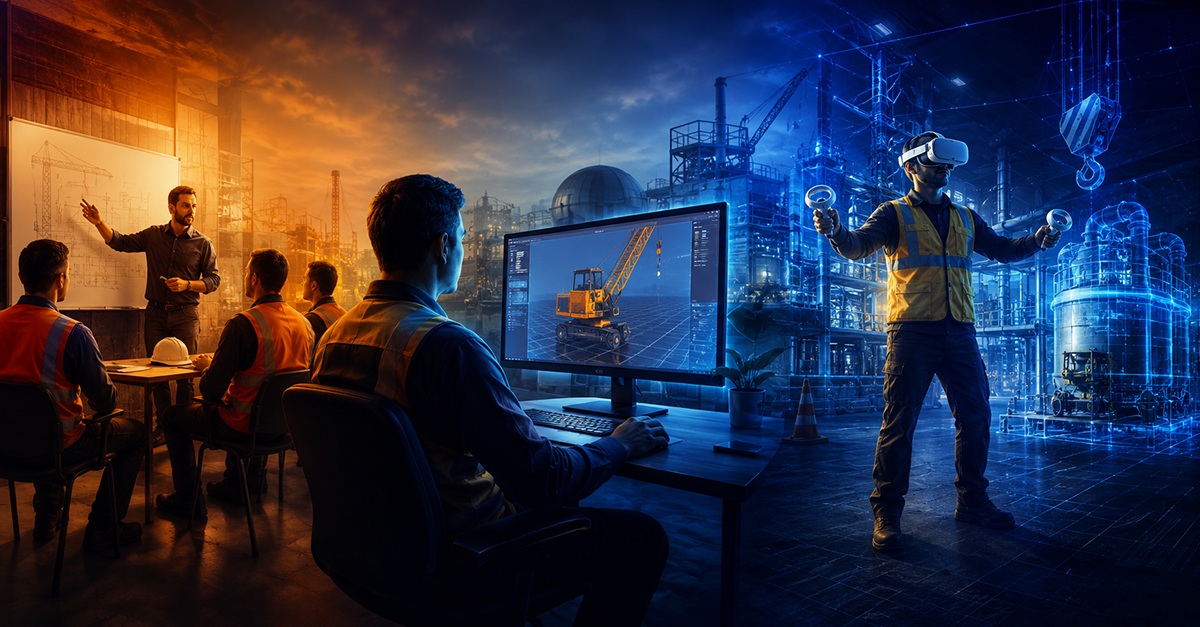
The shift I have watched accelerate over the last two years is not “VR is winning.” That is the wrong framing. The shift is that safety leaders have stopped trying to pick a single modality and started building programs that match the training method to the actual learning objective.
In practice, that looks like three formats working together.
-
eLearning still handles the foundation. Policy, regulatory baseline, onboarding. It is the right tool when the goal is to deliver information at scale and document that it was delivered.
-
Web3D Simulations carry the load that the classroom used to fail at. Interactive 3D scenarios that a worker runs in a browser, on a laptop or tablet, with a keyboard and mouse. No headset, no hardware program, no IT escalation. The worker actually practices the task. The system actually captures what the worker did.
-
VR Training earns its place on the highest-risk scenarios. Confined space, arc flash, fall protection on a real-feeling structure, equipment lockout where a wrong move in the real world ends a career. When the consequence is physical and irreversible, the practice has to feel physical.
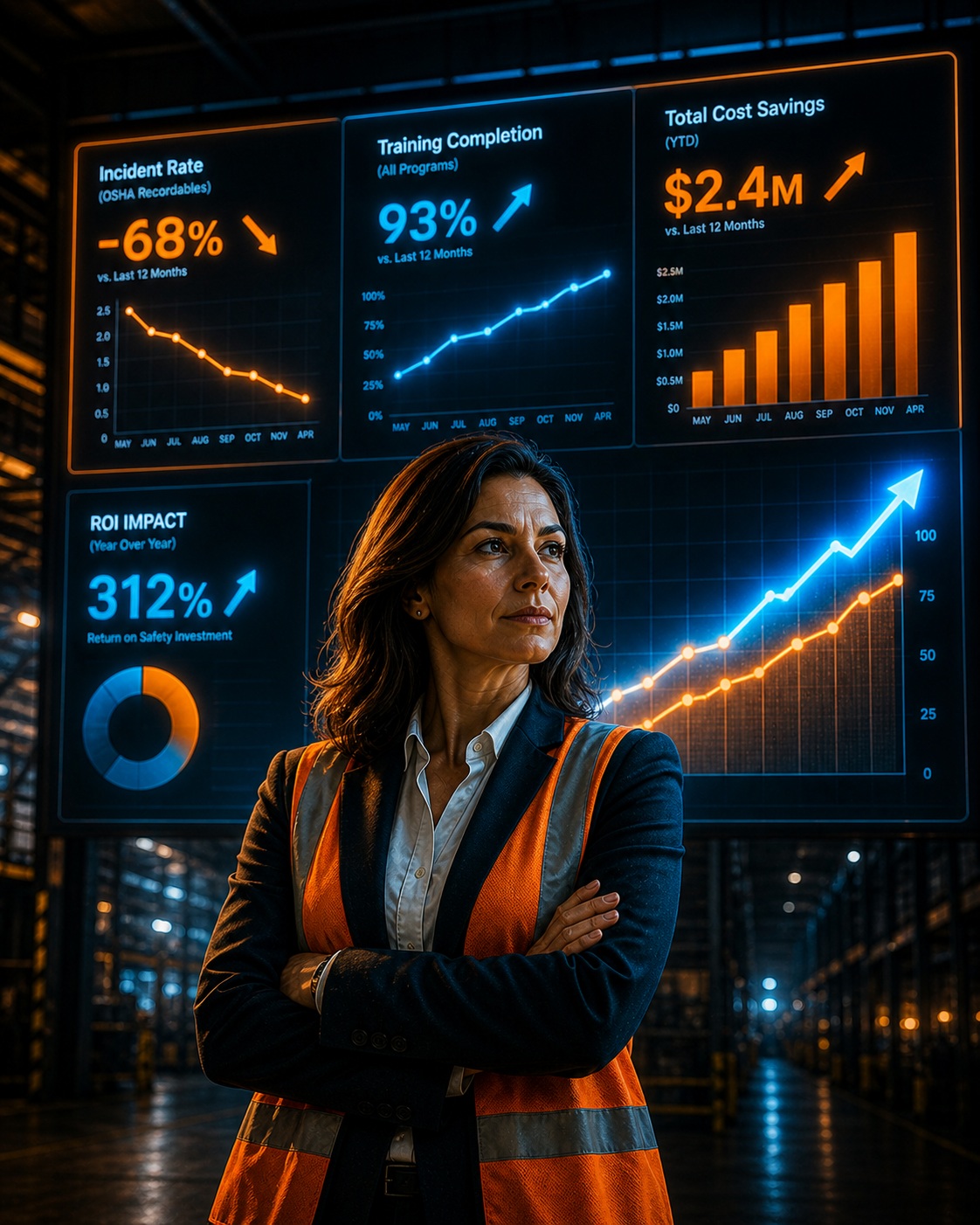
What ties the three together is the thing the old model never had. Centralized data. One reporting surface. A safety leader can look at a dashboard and see who completed what, who performed well, and who needs another rep before they get cleared. That is a different conversation than “did the roster get signed.”
The example I lean on most is our work with Eaton. For about two years now, I have been building custom VR simulations for their electrical equipment training. Magnum DS Breaker. Medium Voltage Switch. NRX Breaker. Switchboard Operations. The interesting part of that program is not the VR itself. It is that Eaton did not throw out their classroom curriculum or their existing eLearning. They layered Web3D versions of those same simulations on top, so workers without a headset could still practice the procedure in a browser. The classroom still carries the foundation. The eLearning still carries the baseline. The Web3D extends practice to the long tail of workers. The VR handles the equipment scenarios where physical presence matters. One source of truth across all of it.
That is what the modern program looks like. Not a replacement. A re-allocation of where each method does its real job.
I built Hard Hat Immersive because I kept watching safety leaders stuck between “immersive but siloed” and “connected but not immersive.” Both options leak. There is a third option now.
The bigger shift
The real argument here is not about tools. It is a learning-science argument the industry has known for decades and is finally able to act on.
Training is practice, not transmission. Workers retain what they do, not what they hear. The classroom model treats learning as something the instructor delivers into the worker’s head. Every piece of evidence going back to Ebbinghaus says that is not how memory works. People remember the procedures they have performed under realistic conditions. They forget the slides.
For 30 years, the industry knew this and could not act on it at scale. Now it can. The companies that figure that out first are going to have fewer accidents, cleaner audits, and crews that actually know what to do when something goes sideways. Which was always the point.
Sharing insights on immersive workforce training, safety technology, and the future of enterprise learning at Hard Hat Immersive.